Showing posts with label science. Show all posts

Wednesday, April 22, 2015

My Earth Day Birthday

...Not to be confused with the Earth's birthday, because it isn't the Earth's birthday.  It's my birthday.  On Earth Day.

I have one gift to add to my list of favorite gifts from students.  She's a mop top or whatever my students are calling them... and now they are popping up all over my classroom right now!


I love having an Earth Day birthday celebration since it's my birthday (any excuse for a party, really), but we got all excited about our reading lesson today and almost ran out of time!

So I threw in my Earth Day go-to... The Lorax.  You just can't have an Earth Day celebration without this guy!  The story fit PERFECTLY with our economics and ecosystem units that we are working on right now, so it was a great high interest lesson.

After our story, we did some reflecting with this prompt page and my kiddos were working really hard on providing evidence for their opinions and responses.


This lesson ended up hitting every topic we are working on right now, so it was a huge teacher WIN.

If you're looking to add some fun activities for your Earth Day celebration next year, I rounded up a few of my favorites (per usual RTL fashion).  I'm not a huge printable person when it comes to Earth Day activities because I feel like it kind of defeats the purpose...right?  Head on over to Pinterest to find Earth related resources, websites, and activities that are fun for the classroom (Project WET and Project WILD are really neat if you ever get a chance to complete a workshop with them!).


I hope you have a wonderful Earth Day... I'm hoping to gift myself a small lemon tree this year, but who knows.  


Thursday, April 9, 2015

Dichotomous Keys {Featured on The Science Penguin}

My blog post about dichotomous keys was featured on The Science Penguin's blog post about great science ideas.  

It is truly one of my most favorite units to teach, so I am thrilled that it is being used and shared.  Check it out!  Whoop whoop!


Wednesday, December 17, 2014

Worry Stones | Science+Stress Free Students

Winter break is so close I can almost taste it.  I finally feel like I'm to the point this year where I can work ahead, so I've been prepping my January materials for a stress-free return.


This time of year can be anything but stress-free for teachers and students.  I'm trying to wrap up our units and possibly squeeze in a few final assessments, while my students are counting down the days to ripping open their presents.  It can be stressful.  For all of us.


During our matter unit this year, I decided to incorporate a little science/art/social-emotional lesson and create worry stones as a class.  I'm always on the look out for new approaches to use with my high anxiety kiddos, and so I thought we'd try this activity this year.  {Shout out to this post at Creative Elementary School Counselor for inspiring this concept for my classroom!}

Our science lessons are always guided by a "big question".  Our big question of the day was:
"Does the shape of a solid change it's mass?"

First we had to figure out if clay was a solid.  Because we had done so much work on classifying matter, this was a pretty short discussion.

We drew our table in our science journals, and included shapes such as "ball #1", "log", "pancake", and "ball #2".  Each group started with a ball of clay, which they weighed and recorded the initial weight ("ball #1").   After they had the weight recorded, they estimated the weight in grams of each clay shape.  Then they proceeded to make each shape and weigh it to see the exact weight.


Imagine their surprise when all the weights were the same!  Once our measurements were completed, we wrote a reflection journal entry answering our "big question".

The next day, I brought in colored clay for us to mold into little worry stones.  We reviewed what we know about the properties of a solid, and how clay fits those properties.  We made our stones {check out this post for instructions}, and I told students I was going to add heat to them by baking them at home.  We made predictions in our science journals about what would happen.  From what we knew, adding heat would melt a solid.

I baked our stones that evening and brought them in the next day, and we wrote our observations in out notebook.  Our observations led to a new discussion- why didn't the clay melt like an ice cube would melt?  I absolutely loved how these activities guided us to authentic conversations and questions about the states of matter.

Now my students and I have our worry stone at our desk every day.  Sometimes they float into our hand when we are talking or working on something.  I love how easy they are to keep in our desk and incorporate as one way to keep our hands busy and help relieve stress.  Plus, if anyone asks about it, my students make me proud and start teaching about solids.


Don't let the stress get to you these last few days before break!  Power through!


Friday, April 25, 2014

Finally Friday #7 {STEAM Education}

A little late getting this up, but hey, it's still Friday, so it's all good.  I also got a little carried away when I started listing all the websites I've been scouring... So here's your FF#7!!  Fridays are busy but if you read this, you'll have something to talk about at happy hour.

It's about to get STEAMy...


I have read a lot this week about {STEAM Education}, so I decided to devote this week's Finally Friday to various articles (along with things I've pinned and an appy infographic) I've come across about it.  They are all similar in that they are describing how it's a growing educational framework.  I wouldn't say this is necessarily a new initiative, but there has been a bit of buzz around it in the past month.  Here we go...full STEAM ahead!


First...what is {STEAM Education}?
Science/Technology/Engineering/Arts/Mathematics

The Christian Science Monitor


EdTech Magazine


If you're feeling Appy:
eSchool News
(also check out below for 60 STEAM Ed Apps)


This site from Education Closet's STEAM Portal is awesome...check it out!

what is steam

{STEM to STEAM} from Rhode Island's University of Design is pushing this initiative. 

US News


Here are the incredible things I've been pinning:

A collection of general school ideas.

Links for tools, ideas, tricks, information and resources to help you teach.

{All My Boards}
In case you want it all and you want it delivered.  Here it is.

or check out my new {STEM/STEAM Board} that I started this week.


A weekly infographic to get you thinking.

We Are Teachers:
60 Apps for Teaching STEAM ≈ ≈ For more STEM to STEAM pins: http://pinterest.com/kinderooacademy/steam-in-early-education/


Saturday, March 29, 2014

Animal Live Cams: Baby Eagles!!

Kids l.o.v.e. animals, which makes my classification unit a peach to teach.  All you do is pop up a picture of some random animal and suddenly they are all spewing random facts about it in your direction.  It's the easiest topic to get them interested in!  

I mean...right?  Just watch this elephant learn to use it's trunk...


When it comes to the Animal Kingdom, I get to teach the {dichotomous key}, vertebrates, and invertebrates.  Our dichotomous key and invertebrates sections have the most new information for fourth graders, so I enjoy those the most.  Plus invertebrates have fun words like cnidarians and echinoderms.

There's nothing better than just observing animals in their natural (or zoo-natural) habitats.  We love to pop in and check up on what they are doing.  Sometimes observing is learning!  Especially in science.  Here are some of our favorite Animal Cams.

Open Sea Cam from Monterey Bay Aquarium:
Live streaming video by Ustream

We loved watching the open sea cam and spotting sharks as they swam by.  We also enjoyed the {other animal cams that the Monerey Bay Aquarium had up}- particularly the penguins.

Typically, we check out the eagles in Decorah, Iowa.  A couple years ago they had eggs that hatched while we were watching and it was the coolest thing!

Eagles in Decorah, Iowa
Live streaming video by Ustream

In doing my research on this, I realized that there are eagle eggs hatching in Pittsburgh RIGHT NOW.  I couldn't get it to upload on my site, so you'll have to go there yourself.  I can't stop watching; it is so amazing!  Right now there is one baby and two eggs.  My students are going to be so thrilled!  I hope the last two eggs wait until at least Monday to hatch...


Here are some other great animal live cams:


Stop by later this week for some more on ideas for teaching invertebrates.

Happy Teaching!

Follow on Bloglovin

Thursday, March 6, 2014

National Geographic Leveled Reading (no strings attached!)

I just love teaching science.  Never did I ever think I would hear those words come out of my mouth, but science and math are the highlight of my days.

Awhile ago I created {this post about Newsela}, which is great for leveling news text for students.  There's a lot of features, including reading levels for the latest articles, so you should check it out if you haven't already.  I'm trying to find good sources for current events since this past year the school cancelled our Time for Kids subscription (is it bad that I'm also disappointed that I don't get the free adult subscription now, too??).  All ideas for something new are welcome!!!

During my search I came across this...National Geographic for Kids.  I get the NG for Kids magazine for our classroom, but not the individual monthly Explorer student magazine.  But no worries, because...

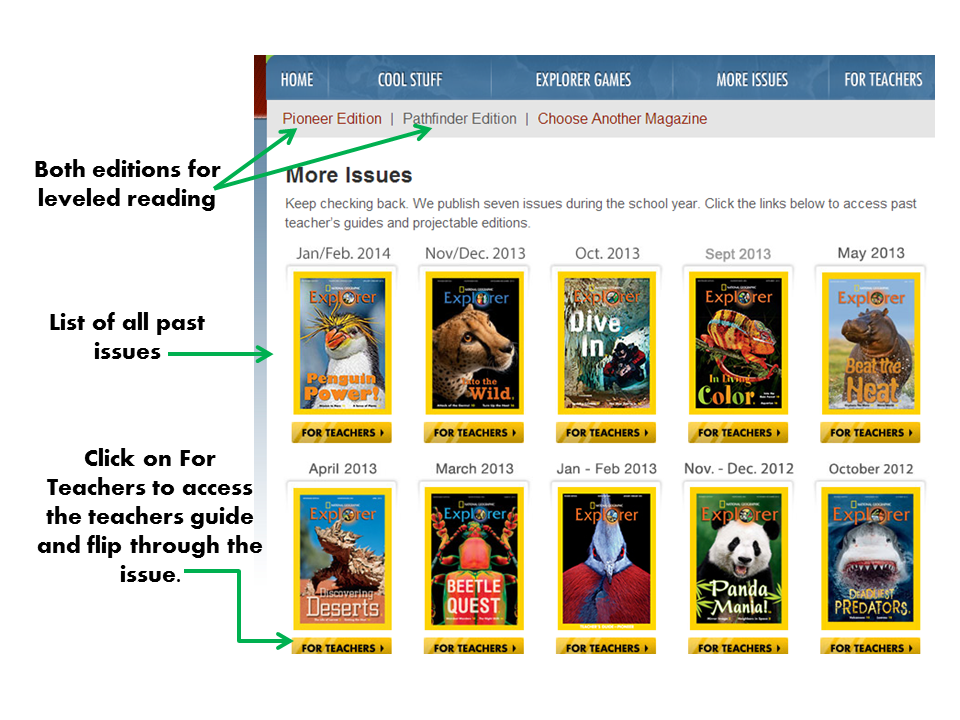
THEY POST ALL THE BACK ISSUES.

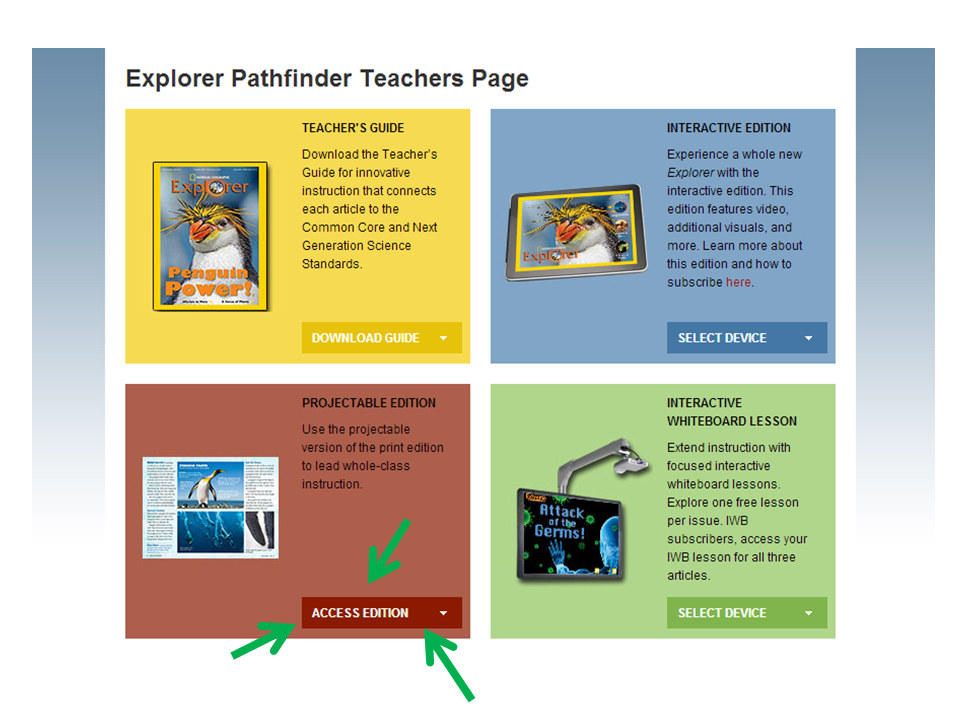
What, what!?!  Not only that, but as my title hints at, the don't have any pesky strings hanging around.  I don't need a subscription or a password to access all this good stuff.  They don't even want me to sign up and create an account with a password I will never remember!  One of the best parts of this discovery was that they post every issue in a "projectable edition" for the Pathfinder Edition AND the Pioneer Edition, so I can grab both copies of the same article at two different reading levels.


 I can project them in all their full colored glory and go through together....or print them for each student to have or to work on in small groups.  Yesssss.

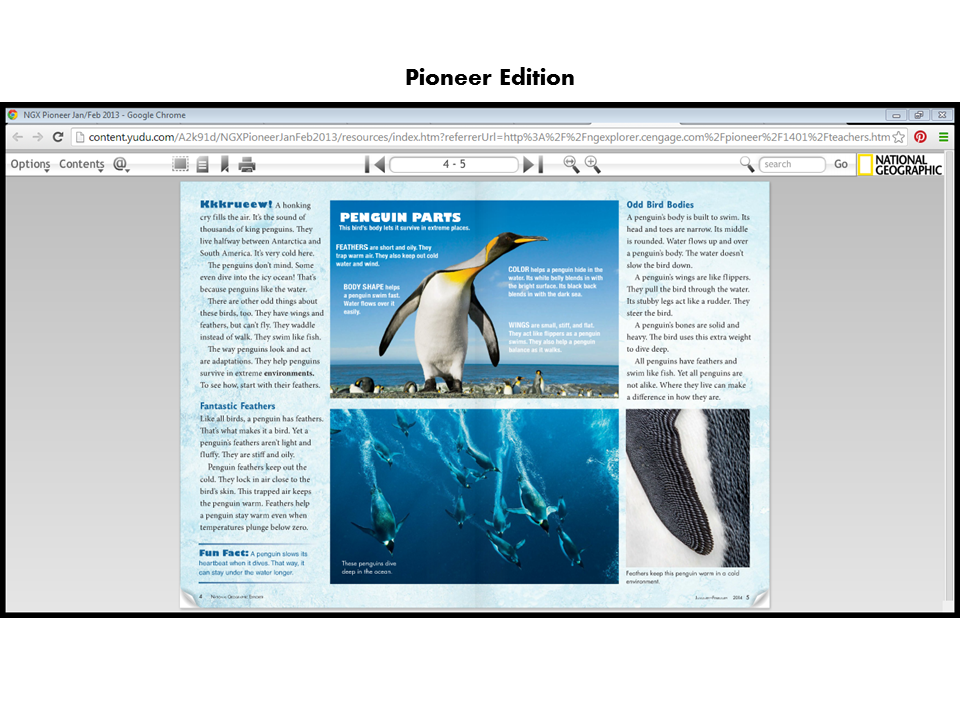
The great part is that both editions look exactly the same (picture-wise) and it's only the text that is leveled.  I love that because I can hand it out and it looks the same to everyone!  Here's a quick glance at the difference between the Pathfinder (4-5th Grades) and Pioneer (2-3rd Grades) Editions:
And for those of you with little(r) ones, they also post the "Young Explorers" (K-1st grade) editions as well (you have to use a different link though- I have it below).  
Now I want to adopt a baby penguin.  

I feel like I hit the non-fiction/leveled reading science jackpot!  

You can click on the pictures above for links, or click below to check it out!